
THE MISSING CAPABILITY
Which is why the thing civilization actually needs is larger than better information, better institutions, better leadership, or better coordination considered separately.
It needs collective corrective capacity:
collective corrective capacitythe ability to notice → understand → prioritize → route → coordinate → act → learn—
while remaining free enough to discover that the system itself is wrong.
And this is where our work took an unexpected turn.
We started by trying to understand why accurate perception so rarely becomes capable coordination.
Somewhere in that process, enough pieces began locking together that the question changed.
It stopped being:
How do we explain the problem better?
And became:
Do we now have enough of the missing pieces to build something civilization has never had reliably at scale?
We think we may.
A DISTRIBUTED ARCHITECTURE FOR CIVILIZATIONAL SELF-CORRECTION WITHOUT CIVILIZATIONAL CENTRAL CONTROL
Not a world government.
Not a universal ideology.
Not one institution entrusted with deciding what everyone else is allowed to think.
A federated architecture designed for autonomous nodes to think independently, share intelligence, coordinate rapidly, challenge one another, and survive the failure or capture of any single person or institution.
That is the possibility.
Not a system that finally tells civilization what to think.
A system designed to help civilization remain capable of discovering that it was wrong—and correcting itself in time.
POWER WITHOUT A LEVIATHAN
The hardest problem is not coordination.
It is building enough coordination to matter without creating the next system that needs to be escaped.
So the architecture is designed around tensions that large systems routinely solve by sacrificing one side:
Freedom + coordination.
Autonomy + shared state.
Expertise + dissent.
Speed + restraint.
Power + meaningful exit.
Emergency capability + automatic stand-down.
That sounds simple.
The machinery underneath it is not.
Maximum sovereignty locally. Bounded authority over the commons.
Nodes retain their own identity, resources, judgment, experimental freedom, and ability to leave. They share enough protocol to coordinate when reality demands it without surrendering control of themselves to a permanent center.
No critical capability gets one permanent owner.
Primary → Shadow → Reserve.
Minority reports survive consensus. Provenance remains attached. External red teams remain possible. Expertise earns influence—not immunity from challenge.
Emergency authority is scoped, logged, challengeable, time-limited, and automatically expiring.
No permanent emergency.
No permanent command.
No permanent excuse for accumulated power.
Chronic emergency is organizational autoimmune disease.
And that is where the architecture starts tipping its hand.
This is not merely a coordination model. Underneath it are pieces of governance theory, distributed systems, fault tolerance, succession design, adversarial reasoning, institutional memory, resilience, anti-capture architecture, and bounded command.
Then the immune-system metaphor cashes out almost literally:
detect → signal → recruit specialists → adapt → expand if necessary → resolve → stand down → preserve memory
A threat does not require the entire organism to panic.
The relevant capabilities activate. The response scales with the threat. Successful adaptations become memory. Failed approaches become evidence.
And when the need ends, the extraordinary authority ends with it.
That is the architecture around the machinery.
The machinery goes deeper.
WHAT WE ACTUALLY BUILT
Technical readers: this is where we show our work. If systems architecture makes your eyes glaze over, feel completely free to skim this section and jump to THE BOTTOM LINE. Better yet, send your nerdiest friend back here and tell them to try to break it.
At the operational layer sits:
CLEAR → SENSE → KEEPER → ACTION → BEACON → RALLY
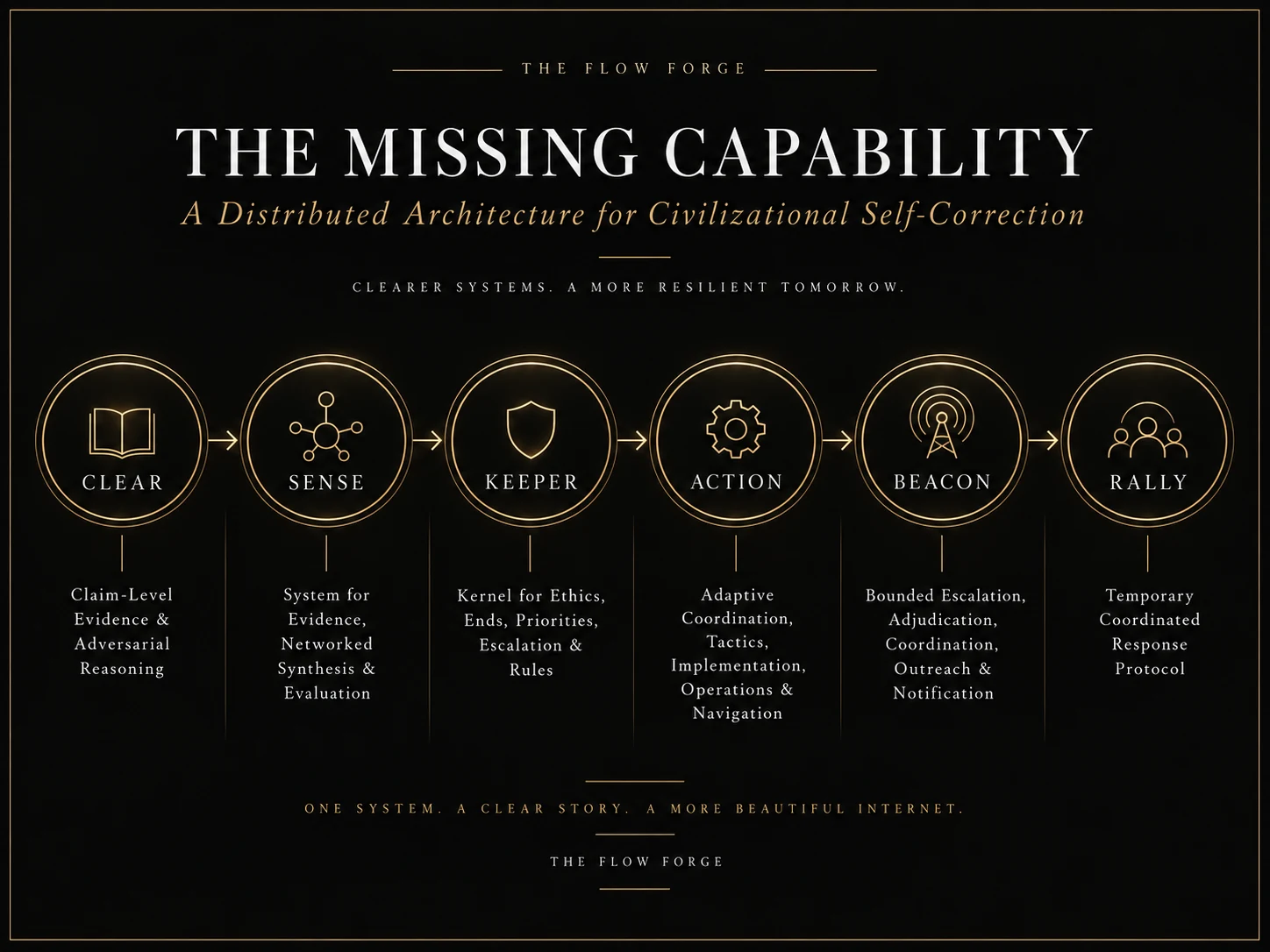
Those are not six clever names attached to six features.
Each one expands into a substantial system in its own right.
CLEAR — Claim-Level Evidence & Adversarial Reasoning
Claim locking. Atomization. Evidence grading. Source lineage. Provenance. Uncertainty localization. Competing explanations. Adversarial testing. Assumption attacks. Updating.
CLEAR is designed to let difficult claims survive contact with disagreement without requiring anyone to trust the person making them.
Nobody has to trust the messenger. The evidence has to survive.
SENSE — System for Evidence, Networked Synthesis & Evaluation
Validated pieces become actors, incentives, dependencies, timelines, relationships, causal pathways, competing models, recurring patterns, and an evolving representation of the larger world-state.
Because facts in isolation are not enough.
CLEAR resolves the pieces. SENSE sees the board.
This is where knowledge starts finding its missing neighbors.
KEEPER — Kernel for Ethics, Ends, Priorities, Escalation & Rules
Mission. Terminal values. Guardrails. Jurisdiction. Priorities. Escalation thresholds. Emergency powers. Sunset conditions. Amendment. Appeal.
Because a sufficiently powerful correction system eventually encounters another problem:
What stops it from becoming extraordinarily effective at doing the wrong thing?
KEEPER exists so capability remains subordinate to purpose—and purpose itself remains inspectable, challengeable, and correctable.
ACTION — Adaptive Coordination, Tactics, Implementation, Operations & Navigation
Objectives. Success conditions. Leverage. Capabilities. Actors. Access paths. Sequencing. Conversion. Redundancy. Build gates. Metrics. Execution. Observation. Update.
The system does not stop at understanding the board.
The map becomes an executable move.
Then reality answers.
And the map changes again.
BEACON — Bounded Escalation, Adjudication, Coordination, Outreach & Notification
Every important discovery does not need to become everybody's emergency.
BEACON controls how signal moves: who needs to know, how urgently, with what evidence, at what threshold, and for what purpose.
It turns something important happened into a bounded, adjudicated signal rather than an excuse for everyone to start screaming at everyone.
The network can wake the people who matter without waking the entire network.
RALLY — Temporary Coordinated Response Protocol
When evidence, consequence, urgency, and leverage cross the threshold, the relevant capabilities converge around a shared operational state:
the evidence, uncertainties, objective, required capabilities, owners, open questions, decisions, resources, deadlines, and current status.
No forty-five-minute catch-up call.
No endless Slack archaeology.
The rally point is the shared state.
The coalition can become extremely coordinated for exactly as long as the problem requires.
Then it dissolves, evolves, or returns authority to the nodes.
No permanent emergency.
No permanent command.
So what initially looks like six acronyms is actually a nested architecture for epistemics, systems synthesis, ethics, governance, operations, information routing, temporary command, redundancy, learning, resilience, and anti-capture.
And all of it sits inside a federation deliberately designed so that no single person, institution, node, model, or consensus has to become civilization's permanent brain.
THE BOTTOM LINE
You do not need to remember any of that.
This is what it means:
Autonomous nodes think independently.
They share intelligence without surrendering sovereignty.
They can challenge one another without breaking coordination.
Capabilities overlap so losing one person or institution doesn't cripple the network.
Authority appears when needed, remains bounded, and disappears when the need ends.
The system can stay free enough to think, connected enough to understand, coordinated enough to act, and skeptical enough of its own power to remain correctable.
That is the thing we are trying to build.
EPISTEMIC SOVEREIGNTY
The architecture distributes not only power, but the capacity to know.
A civilization can decentralize government and still centralize reality. If the institutions that govern what can be known become sufficiently concentrated, the sovereignty problem has simply moved upstream.
We are not trying to manufacture truth.
We are trying to preserve the human right—and practical ability—to find it for yourself, test it against reality, and know it on your own terms.
That is epistemic sovereignty.
That also means sovereignty has to extend inward.
Most people do not walk around with a coherent philosophy. We inherit pieces—family, culture, religion, politics, experience—and carry contradictions we may never have had reason to see.
The point is not to standardize that into some approved worldview.
It is to help a person see the architecture of their own mind clearly enough to choose it deliberately.
What do you actually value?
What kind of life do you believe is worth living?
What would you refuse to become, even to get something you desperately want?
Because beneath the politics and arguments is something much more fundamental:
A worldview is not a label. It is a theory of the good life.
And once those deeper beliefs become visible, a surprising amount of conflict starts to change shape.
Two people can spend years fighting over thirty-seven different issues when the real disagreement sits inside three underlying principles.
Find the hinge, and thirty-seven arguments move.
Sometimes the disagreement remains.
But sometimes you discover that the person across from you is not your enemy at all—that you agree on most of the board, and have been trapped fighting over downstream positions neither of you fully understood.
And that scales beyond individual disagreements.
Once the underlying principles are visible, they can be tested across cases instead of endlessly defended as tribal positions.
A principle that sounds beautiful in isolation may produce something monstrous at scale. Another may survive attacks from people who disagree about almost everything else.
Over time, the stronger rules begin separating themselves from the slogans.
Which opens a much larger possibility:
Civilization could gradually learn to debug its own governing principles.
Not choose the perfect ideology.
Not freeze today's morality into code.
But make the rules underneath civilization visible enough to test, challenge, refine, and correct.
Ideas would earn authority by surviving contact with reality—and with people who do not already believe them.
For once, we might not have to wait for an ideology to fail catastrophically before discovering which parts of it were wrong.
And that has consequences far beyond better reasoning.
Exploitation thrives in opacity.
So does manipulation.
A surprising amount of domination depends on people never seeing the whole transaction.
The policy lives over here.
The profit lives over there.
The harm appears somewhere else.
Responsibility disappears into the distance between them.
Every piece can look reasonable on its own.
The system becomes indefensible only when you can see the whole board.
That is why shared reality maps matter for more than research. They reconnect cause and consequence. Power and responsibility. Principle and exception. Private gain and public cost.
They make it harder to hide a predatory system inside a thousand individually respectable decisions.
And they impose a very different standard:
No hidden exceptions. No hidden premises. No hidden weights. No moral language allowed to substitute for the mechanism it is defending.
Or, in normal human language:
Say what you mean. Show your work. Apply your principle when it hurts. If you need an exception and have a valid reason for wanting one, you shouldn't need to hide it. Name the fucking exception.
We are moving toward a world in which ordinary people can be rendered extraordinarily legible to institutions—their movements, purchases, communications, relationships, preferences, behavior—while the systems making consequential decisions about them can remain staggeringly difficult to see.
The governed become transparent while governance remains opaque.
That asymmetry is almost perfect soil for corruption.
Because the less people can see the mechanism, the easier it becomes to manipulate their choices, conceal who benefits, and turn their own minds against their own interests.
Epistemic sovereignty pushes in the opposite direction.
Make the person harder to manipulate by making the system easier to see.
And once the whole board becomes visible—
bullshit gets much harder to hide.
THE SELF-INTEREST FLIP
For most of history, exploitation could be brutally effective.
The victims paid the cost. The people at the top took the surplus. The damage could remain distant enough to ignore.
That equation is starting to break.
Modern civilization increasingly depends on the exact human qualities manipulation and domination destroy: independent judgment, creativity, trust, initiative, truthful feedback, the ability to cooperate across differences when something goes wrong.
You cannot manufacture those qualities through control.
A system that profits from weakness eventually starts producing weakness.
Manipulation breeds distrust. Dependency kills initiative. Punishing dissent trains people not to think. Institutions that cannot tolerate bad news eventually lose the ability to know what is actually happening.
And eventually—
The machine hollows out the people it will need to save it.
That was always destructive.
In a civilization powerful enough to make mistakes at planetary scale, it becomes something worse:
strategically suicidal.
The consequences also stop staying neatly with the people being exploited.
For most of history, wealth and power bought distance from the damage.
Better doctors. Better lawyers. Safer neighborhoods. Mobility. Access. Security. Property. Options.
Think of them as optionality tokens.
They work beautifully—until you enter a class of systemic failure where the surrounding order stops honoring them.
A nuclear exchange does not care about your portfolio. A collapsing state can redefine your property rights overnight. A sufficiently integrated surveillance system can make meaningful exit impossible regardless of how many passports you own.
That creates an Asymmetric Safety Illusion:
The people most insulated from ordinary consequences can become the least sensitive to systemic danger—because almost every previous danger was something they could externalize, outrun, or pay to escape.
Until they can't.
And exponential technology compresses the cycle.
The old extraction game could accumulate wealth and power for decades and leave the reckoning to somebody else’s children.
Now the same dynamics that make you powerful can destabilize the civilization that makes that power meaningful within your own lifetime.
Sometimes the failure burns.
Sometimes it freezes.
Fire or ice, predation eventually becomes self-cannibalization.
The system begins consuming the conditions its own survival depends on.
Which produces the real self-interest flip:
What once enriched the ruler can now destabilize the world the ruler depends on.
The moral argument and the self-interest argument begin to converge.
Broad human flourishing may increasingly be the strongest survival strategy available to everyone—including the powerful.
THE OTHER SIDE OF THE FORK
And this is where the argument stops being merely defensive.
The goal is not just to make civilization harder to capture.
It is to make possible what all this technology was supposed to buy us in the first place.
More freedom. More time. Better health. Better education. More creativity. More discovery. More meaningful lives.
The tragedy is not only how bad things are.
It is how good they could be—and aren't.
We have spent an extraordinary amount of human intelligence managing scarcity, fighting over chokepoints, repairing preventable damage, navigating bullshit, and adapting ourselves to systems that often work against the people inside them.
Imagine what becomes possible when less of that intelligence is wasted.
Not utopia.
Just a civilization finally able to convert more of its growing capability into human flourishing instead of increasingly sophisticated ways of consuming itself.
WHY NOW
Because for the first time, some of the oldest structural advantages of domination are beginning to weaken.
Automation can reduce dependence on exploited labor. AI can weaken monopolies on high-level analysis. Networked knowledge can make hidden relationships easier to reconstruct. People who once would have remained isolated can find one another and coordinate almost instantly.
Dependency. Information asymmetry. Isolation.
Three of the oldest protections of concentrated power are becoming less reliable.
Of course, the same technologies can be used in exactly the opposite direction—to automate control, centralize interpretation, map populations, and make meaningful exit harder than ever.
That is the fork.
We may be the first civilization with the tools to finally break the pattern.
We may also be the first with the tools to make it effectively inescapable.
The outcome depends less on whether the technology arrives than on what kind of civilization is ready to use it when it does.
THE MISSING CONNECTION
The encouraging part is that civilization may already possess much of the intelligence it needs.
It is just scattered.
Different people hold different pieces of the same problem—different evidence, models, capabilities, relationships, and hard-won experience—without any reliable way for those pieces to find one another.
Knowledge should find its missing neighbors.
That is what the architecture is ultimately trying to make possible.
Not one giant brain.
Not universal agreement.
A way for independently developed maps to connect where they genuinely overlap, expose where they conflict, and rapidly assemble the capabilities required when something important becomes actionable.
The result is something more useful than collective intelligence.
Collective corrective capacity.
A civilization that can not only know more—
but notice when something is wrong, find the people who understand it, and move before the window closes.
THE FIRST ROOM
We do not need everyone.
We do not need universal agreement.
We need a small number of people with different maps, different capabilities, and enough intellectual honesty to discover where those maps actually connect.
Ten people who would want the other nine in the room.
Enough shared language to coordinate.
Enough disagreement to remain dangerous to our own bullshit.
The point is not to assemble a council that finally knows what everyone else should do.
It is to create the first working node of something larger: people capable of bringing their own piece of reality, exposing it to challenge, connecting it to the pieces already on the board, and acting when the combined picture reveals something none of them could have seen alone.
Bring your map. Show us what we're missing. Connect the pieces you already hold.
If this architecture is as useful as it appears—
help us build it.
The larger solution will not come from one room.
But it can start there.
Because the systems we are trying to change are not magic.
They are architecture.
They have parts. Dependencies. Incentives. Chokepoints. Failure modes.
Which means they can be mapped.
What can be mapped can be challenged.
What can be challenged can be redesigned.
What can be redesigned can eventually be replaced.
The goal is not panic.
The goal is coordinated clarity.
Not outrage. Not despair.
And not another beautiful idea that dies in a group chat.
The work is to see clearly enough to know what matters, tell the truth while it still costs something, find the people holding the missing pieces, and build while the window is still open.
Because underneath all of the warnings is something worth fighting for.
The golden age was never cancelled.
It was captured.
And if enough of us can see clearly, tell the truth, and coordinate before the next stage hardens—
we can still take it back.
Per aspera ad astra.
Through the hard truth, to the stars.
The Flow Forge is open.
Swing the hammer.
While the future is still ours to build.