
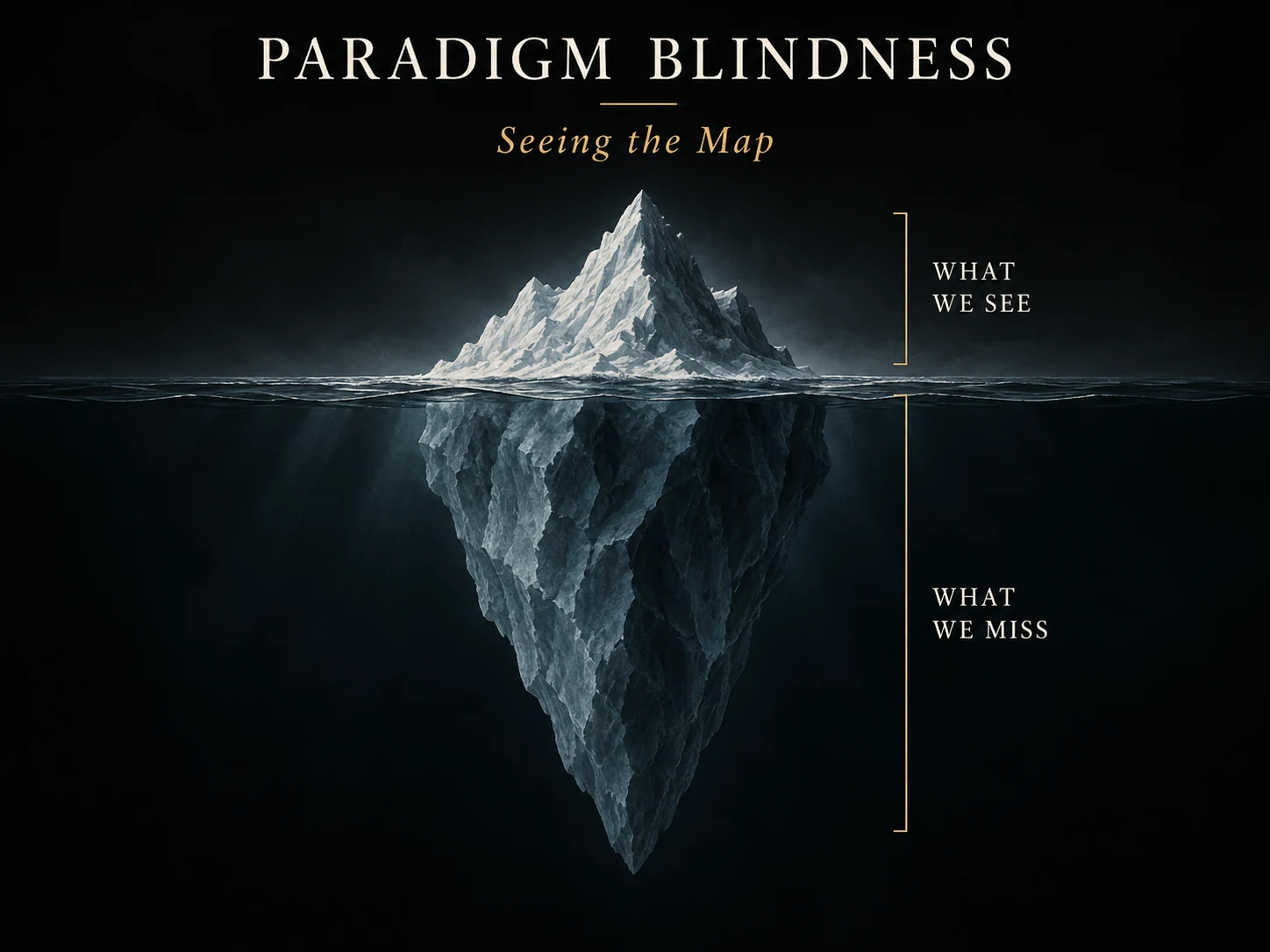
PARADIGM BLINDNESS
Socially Negotiated Plausibility
Why intelligent people can know the facts and still fail to see the pattern.
The facts are permitted.
The pattern is forbidden.
Slavery can be true.
Propaganda can be true.
Corporate deception can be true.
Coups can be true.
Captured regulators can be true.
Mass surveillance can be true.
Institutional atrocities can be true.
Each fact gets its own drawer.
What becomes dangerous is asking:
What are all of these things evidence of?
Power does not always need to hide the evidence.
It only needs to make the conclusion socially unacceptable.
That is Paradigm Blindness.
It is not simply ignorance.
It is knowing the facts while being unable to psychologically survive what they mean.
THE QUESTION
My journey down this path started with a simple question more than twenty years ago:
Has there ever been a single time in recorded history when the dynamics of corruption and concentrated power were successfully and durably overcome—creating a large-scale civilization with broad freedom, broad prosperity, low corruption, low exploitation, and long-term stability?
Put more bluntly:
Has there ever been a large-scale society without an exploited labor class, systematic perception control, and a persistent extraction layer sitting on top?
History’s answer is brutally consistent:
No.
That has never happened.
Anywhere. Ever.
Paradigm blindness is what happens when people are taught that one of the oldest and most significant forces in human history either does not exist, does not matter, or is not meaningfully involved in the systems shaping their lives.
People can know the facts, yet remain unable to accept what those facts mean because the conclusion violates their permitted model of reality.
The Hard Truth:
Most people think truth determines what they believe.
It often doesn’t.
We like to imagine that we examine the evidence, decide what is true, and adjust our worldview accordingly.
Human beings are not nearly that clean.
Before seriously asking “Is this true?”, we often subconsciously ask:
Am I allowed to believe this?
Who else believes it?
What will it cost me?
What does it threaten about my identity, status, relationships, career, politics, or worldview?
And if it is true—what would I have to do?
Only then does truth get its vote.
I call this Socially Negotiated Plausibility.
And underneath it is one of the ugliest laws of persuasion:
People protect status before truth.
Not merely social rank.
People like to think of themselves as reasonable, cautious, professional, moral, balanced, and responsible.
The disturbing part is what happens when maintaining that identity requires sacrificing the truth.
What that sacrifice actually creates is something no one wants to recognize in themselves: a selfish and increasingly delusional worldview—one they may defend even at the cost of truth, their stated principles, and the well-being of others.
History is littered with the consequences.
Nazi Germany
An educated, technologically advanced society normalized persecution, dispossession, mass murder, and genocide.
Communist China
During the Great Leap Forward, ideology, fear, conformity, and punished truth helped sustain catastrophic policies through one of the worst famines in human history.
Liberal-Democratic America
A nation founded on liberty and equality simultaneously practiced Indigenous dispossession, chattel slavery, segregation, Jim Crow, and generations of institutionalized exploitation.
This is not an ideology problem.
It is a human-and-power problem.
In each case, millions of ordinary people lived inside systems producing extraordinary harm while the surrounding culture supplied reasons that participation, silence, disbelief, or compliance could still feel normal, respectable—even moral.
Paradigm blindness does not feel like blindness from the inside.
It feels like common sense.
We protect, almost automatically, the entire structure that tells us who we are, who is credible, what is normal, which institutions are legitimate, and what conclusions respectable people are allowed to reach.
When a conclusion threatens that structure, discomfort often arrives before analysis—and the mind starts looking for an exit.
The evidence is not the hard part.
The cost of seeing is the hard part.
So let’s test that.
Go back to the original question.
For almost everyone, the immediate response is some version of:
“That can’t be right?”
Unfortunately, it is.
In more than twenty years of asking that question, I have heard endless objections.
What I have not been given is a clean counterexample.
But that isn’t even the interesting part.
The interesting part is what happens next.
The claim should be challenged.
But there is a difference between falsifying it and trying to escape what it means.
Once the implication becomes uncomfortable, watch what happens:
What exactly counts as “large-scale”?
How long does “durable” really mean?
Maybe there was a smaller society somewhere that qualifies?
Maybe that exploitation wasn’t severe enough to count?
Maybe we can leave perception control out of it, and overlook a few signs of parasitic extraction.
The search for truth quietly becomes a search for an escape hatch.
At some point, falsification becomes negotiation.
We stop testing the claim and start bargaining with its implications—by bargaining away the criteria.
A genuine counterexample is welcome. What does not count is successively weakening each condition until something can be made to fit.
Before trying to negotiate your way around it, sit with the implications of that. Why do people try so hard to avoid this one simple and obvious truth?
Because if this is true, then corruption, exploitation, concentrated extraction, and systematic attempts to control human perception are not occasional glitches in civilization.
They are the dominant recurring operating pattern.
Across continents.
Religions.
Ideologies.
Governments.
Economic systems.
The forms change.
The underlying architecture does not.
Exploited human beings beneath.
Systems of perception control throughout.
A parasitic extraction layer above—converting concentrated power into private gain while pushing costs downward.
Societies have made enormous moral and material progress.
But the deeper operating pattern was never defeated.
It adapted.
As overt brutality became less socially acceptable, power learned to become more respectable.
Coercion acquired the tool of manufactured dependency.
Censorship merged with narrative management.
Naked extraction became increasingly complex systems of fees, debt, rents, permissions, incentives, and institutional control.
The machinery became more politically acceptable, socially palatable, legally defensible—and harder to recognize for what it was.
The old systems were often crude enough to see.
Slaves. Serfs. Castes. Forced labor. Colonial subjects. Debt bondage.
Kings. Priesthoods. Censors. Propagandists.
Monopolies over land, law, violence, information, and access.
Modern systems rarely announce themselves so clearly.
The pattern did not disappear.
It learned how to make itself comfortable.
But beneath the changing forms, the underlying logic remained brutally simple:
Human civilization has repeatedly turned human beings into yield.
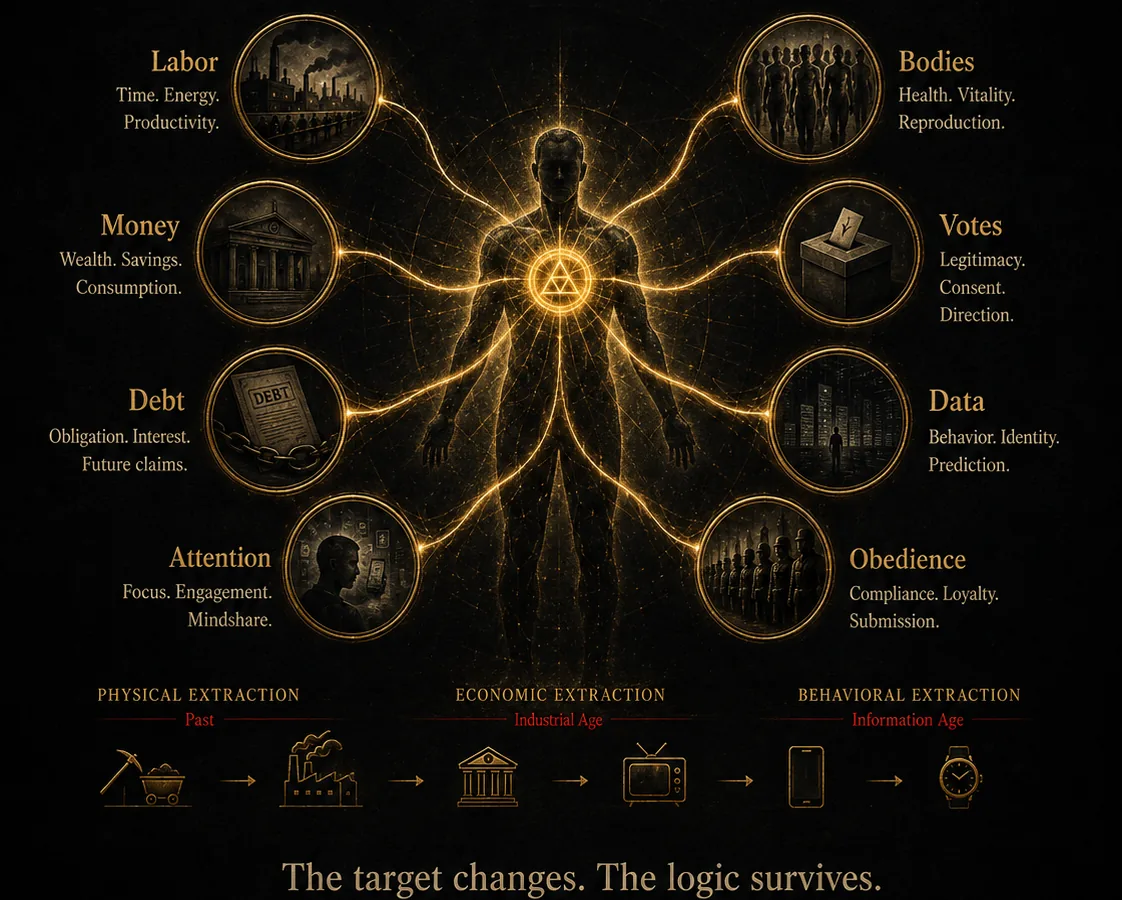
Even our greatest moral victories have usually eliminated forms of domination without eliminating the underlying dynamics.
America abolished chattel slavery.
Sharecropping, convict leasing, debt peonage, exclusion from land and credit, and other mechanisms of dependency followed.
The institution changed.
The power dynamic adapted.
This does not mean every civilization is equally oppressive.
It means something much harder:
We have never driven exploitation, systematic perception control, and parasitic extraction out of the core machinery of civilization.
For most of recorded history, across nearly every large-scale civilization we can examine, all three have remained first-order forces at the heart of civilization—not peripheral abuses, but recurring mechanisms through which power is organized, accumulated, protected, and reproduced.
We have constrained them. Reformed them. Renamed them. Made some forms less brutal.
We have never made them marginal.
So the real question is:
What force is powerful enough to keep reproducing the same architecture across radically different civilizations?
Why do civilizations separated by centuries, continents, religions, ideologies, and economic systems repeatedly produce the same underlying machinery of exploitation, perception control, concentrated power, and institutional self-protection?
What happens when that ancient architecture acquires technologies capable of making it predictive, automated, scalable, and potentially impossible to escape?
And perhaps most strangely:
Why, despite thousands of years of repetition, do intelligent people have so much difficulty confronting what the pattern means?
Which brings us back to the paradigm.